Highway Driving in India: 10 Essential Tips for Safe Day and Night Drives
Key Takeaways
- Inspect your vehicle before you even head out. This includes brakes, tyres, lights, and fluid levels.
- Unless overtaking, stick to the left lane. Zig-zag driving is responsible for more highway accidents than one would think.
- Maintain a minimum distance of 3 seconds from the vehicle ahead in daylight. And increase it up to 4-5 seconds during nighttime and/or rain.
- Speed limit applies only under favourable road conditions. It must be reduced during fog, rain, and nighttime driving.
- Safety tips for night-time driving consist of only three things. You must dim your headlights when there is oncoming traffic, increase your following distance, and know when to simply stop driving.
- Take regular breaks every couple of hours. Caffeine and loud music will not solve your tiredness issues, only cover them up for a while.
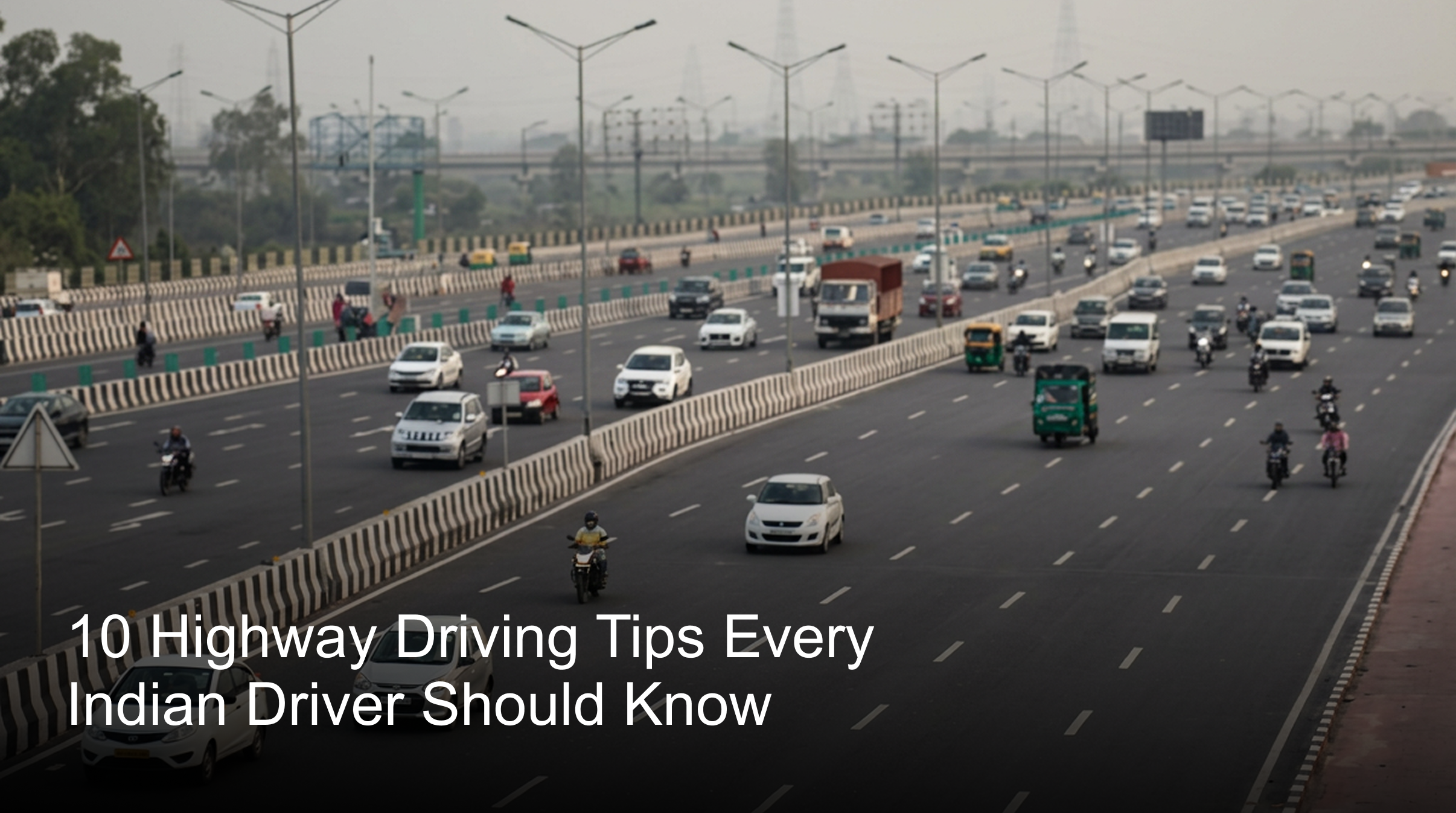
There is a distinct thrill that everyone feels before their first driving experience on highways in India. The hustle and bustle of city traffic disappears, and your speed meter ticks up to 80. But you may also get to share the road with long-distance trucks, an obviously derelict state bus, possibly a bullock cart, and some guy in a Swift speeding by in the opposite lane at 120. Indeed, the highways of India are unpredictable, and that is precisely what makes it challenging for new drivers.
So, adequate preparation prior to starting your journey always helps, and therefore, you must go through the essential highway driving tips. It’s crucial to remember to check your vehicle before you leave, don’t crowd the car ahead of you, drive to the actual road conditions instead of the number on the signboard, and be extra alert once it gets dark, since that’s when most avoidable highway accidents happen. This guide will help you to make your first-time highway ride safe and stress-free.
Why Do Indian Highways Demand Extra Caution?
While we may think of highways and city roads as the same, in reality there are differences between them in terms of speed, traffic conditions, and the consequences of making errors. The statistics speak for themselves in this case.
As per the MoRTH Road Accidents in India 2024 report, 4,87,707 road accidents and 1,77,175 deaths have occurred in 2024 across the country. Among them, only national highways account for 1,50,958 accidents and 64,772 deaths. That’s really the whole reason highway driving tips need to exist separately from general road safety advice.
What Are the 10 Highway Driving Tips Every Indian Driver Should Know?
Most highway accidents in India come down to a handful of avoidable habits rather than freak circumstances. These 10 highway driving tips cover the whole trip, from getting your car ready before you leave to what you do if something still goes wrong anyway.
Tip 1 – Inspect Your Car Before You Leave
Before you set out, check your brakes, tyre pressure and tread on all four tyres plus the spare. Top up your coolant and washer fluid, and make sure the wipers actually clear the windscreen properly. Also keep your RC, insurance, licence, and PUC certificate close. Well, if you’re renting instead of using your own car, this is one thing you can skip worrying about. Revv vehicles come pre-serviced with insurance.
Tip 2 – Follow Lane Discipline: Left to Cruise, Right to Overtake
On a multi-lane highway, the left lane is for regular cruising, and the right lane is for overtaking only. A lot of highway collisions in India happen simply because of zigzagging between lanes without indicating or overtaking from the left because the right lane happens to be busy. Don’t do that. If the car ahead won’t move over, wait it out, flash your headlights, or use the horn.
Tip 3 – Maintain a Safe Following Distance
Among the highway driving tips, the 3-second rule works the best even if you’re not great at estimating distances. Pick a fixed point up ahead – a signboard, a tree, whatever – and start counting when the car in front of you passes it. If you reach that same point before you finish counting to three, you’re too close. Push that out to 4-5 seconds at night or in the rain, since your stopping distance goes up right when your visibility goes down.
Tip 4 – Match Your Speed to Conditions, Not Just the Limit
A speed limit sign is basically assuming dry roads, clear skies, and daylight. It has no idea about the fog outside Agra at 5 am or a sudden downpour on the Mumbai-Pune Motorway. In rain, drop your speed by at least 15-20 km/h and widen your following distance. In fog, use your fog lights rather than high beams. Around construction zones and toll plazas, expect sudden lane merges and start slowing down early rather than at the last barrier.
Tip 5 – Keep Extra Distance from Trucks and Buses
Heavy vehicles have huge blind spots. A rough rule of thumb: if you can’t see the driver in their mirror, they probably can’t see you either. When you do overtake a truck or bus, signal clearly, use your headlight dipper or horn to let the driver know you’re there. This is one of those highway driving tips that gets repeated a lot for good reason.
Tip 6 – Master Night Driving Safety on Highways
Turn your headlights on before it actually gets dark, not once you’re already struggling to see. Use high beams only on empty, unlit stretches with nothing coming from either direction, and dip them the moment you spot another vehicle within roughly 200 metres. Shift your gaze to the left edge of the road if the glare from another vehicle is disturbing you. It sounds like a small trick, but it prevents a surprising number of near misses at night.
Tip 7 – Plan Fuel, Toll and Rest Stops in Advance
Before a long drive, roughly map out where the fuel stations and FASTag-enabled toll plazas are along your route, especially through stretches with fewer towns. A lot of petrol pumps and roadside dhabas on state highways shut once you’re past 10 or 11 pm, so don’t assume you’ll find one whenever you need it. It’s an underrated one on this list of highway driving tips, mostly because people only think about it after they’ve already run into the problem.
Tip 8 – Watch for Pedestrians, Cyclists and Stray Animals
Village huts, shops and small settlements sit right along the road for a lot of the Indian highway route. Therefore, you will often get pedestrians, cyclists, and stray cattle on the road. Slow down as you approach any habitation area, and keep scanning the road edges instead of only looking straight ahead. And remember that after dark, an animal standing still on the road can be genuinely hard to spot until you’re already close.
Tip 9 – Beat Fatigue: Break Every Two Hours
Make it a rule for yourself: stop every two hours, even before you feel tired. Watch for the early signs such as drifting slightly out of your lane, heavy eyelids, missing an exit you knew was coming up, or realising you don’t actually remember the last few kilometres. None of that gets fixed by turning up the music or drinking another coffee. The only real fix is stopping and actually resting, even if it’s just 15-20 minutes to get out and stretch.
Tip 10 – Know What to Do in a Breakdown or Emergency
If your car breaks down, try to get it fully off the carriageway. Even a vehicle that’s half off the shoulder is a hazard for everyone coming up behind you. Switch your hazard lights on right away, and place a reflective triangle roughly 50 metres behind the car to warn approaching traffic. Get everyone out and well clear of the vehicle, and don’t stand behind it while you wait for help. That’s genuinely the most dangerous spot to be in during a breakdown.
What Should Be in Your Highway Emergency Kit?
No list of highway driving tips is really complete without mentioning an emergency kit. It doesn’t take up much boot space and can genuinely matter if something goes wrong far from help:
- Reflective warning triangle
- Torch or flashlight with spare batteries
- First-aid kit (bandages, antiseptic, any personal medication you take)
- Power bank, kept fully charged
- Extra drinking water
- Basic toolkit (screwdriver, pliers, wrench)
- Tyre inflator or puncture repair kit
- A list of emergency numbers: highway patrol, nearest hospital, roadside assistance, and someone you’d actually call
Hitting the Highway? Rent a Road-Ready Car from Revv
Not everyone wants to put highway kilometres on their own car or deal with getting it serviced before a big trip. Revv’s fleet comes pre-serviced, with insurance and maintenance already sorted. So, you’re not starting your trip with Tip 1 on this list still hanging over you. You can pick a car suited to your route too.
Your rented car will come with a complete maintenance check, which takes one more thing off your own list of highway driving tips to worry about.
Book through the Revv app and get the car delivered to your door.
Conclusion: Drive Prepared, Stay Alert, Enjoy the Highway
All of these highway driving tips really point to the same basic idea: highway driving in India rewards preparation a lot more than confidence. A car that’s actually been checked before you leave, a following distance that gives you room to react, and slowing down when conditions call for it will get you through most situations a highway can throw at you.
Save this before your next long drive, or pass it on to someone about to attempt their first one. And if you want a fully secure highway journey without distressing your own car, then choose a self-drive car rental company like Revv just before your trip.
Frequently Asked Questions
The key highway driving tips include checking the condition of the vehicle before starting, maintaining lane discipline (left for cruising and right for overtaking), maintaining sufficient following distance, and taking rests every few hours. These are enough to avoid most errors committed by beginners while driving on highways.
Follow the 3-second rule among the highway driving tips during the daytime. Choose an object on the road and pass it no sooner than 3 seconds after the vehicle ahead of you crosses it. Increase the distance to 4-5 seconds at nighttime or in rainy weather.
Drive in the left lane under normal circumstances and overtake using the right lane. Do not overtake from the left lane because it is one of the major reasons for accidents on highways.
Start using your headlamps early in the evening, switch to high-beams when there is darkness and emptiness on the road, and dim them when you approach another car. Furthermore, if the headlights of the coming cars are dazzling, then shift your gaze to the left edge of the road.
Ideal highway driving tips suggest taking at least one break in every two hours because proper rest will help you remain alert while driving. Breaks can be taken at an earlier stage than two hours during long drives if you are feeling any signs of drowsiness.
If possible, get out of the roadway entirely, switch on your warning lights, put a reflective triangle 50 metres behind your car, and ensure that all people stay away from the vehicle. Also, highway driving tips suggest you not stay near your car when waiting for assistance.
Yes, it is safe, but the risk factor is definitely higher as compared to driving during the daytime. This is mainly due to the lack of lighting, glare due to high-beam lights, and tiredness of the driver due to driving continuously for long hours.